 Arabic
 Design Your Website Now!
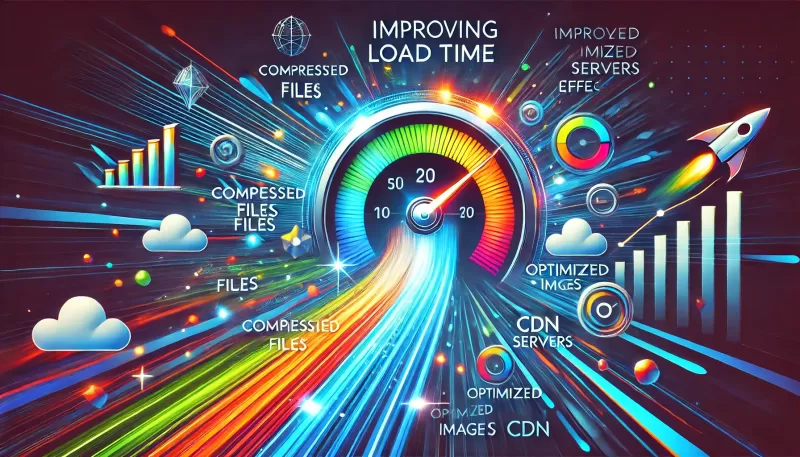
To improve your website's load time, start with the biggest wins: compress files (Gzip or Brotli), reduce HTTP requests, optimize images as WebP, use a CDN, enable caching, cut JavaScript and upgrade hosting if needed. Measure before and after with PageSpeed Insights. Below we explain each method.
Improving your website\'s load time is crucial for ensuring an excellent user experience and enhancing your site\'s ranking in search engine results. In this article, we will explore effective steps you can take to improve your website\'s load time, making it faster and more efficient.
File compression is one of the most effective ways to improve load time. You can reduce the size of HTML, CSS, and JavaScript files by using techniques like Gzip or Brotli. This reduces the time needed to transfer files from the server to the browser, significantly improving load time.
The more requests a user\'s browser sends to the server, the longer the load time. To reduce this number, you can combine CSS and JavaScript files into one, minimize the number of images used on pages, and use embedded icons (SVG) instead of images where possible.
Large, unoptimized images are often the main cause of slow website load times. You can optimize images by using modern formats like WebP, adjusting image quality, and resizing images to fit the needs of the site without sacrificing quality. Tools like TinyPNG and ImageOptim can significantly help in optimizing images.
A Content Delivery Network (CDN) helps reduce load time by distributing your website\'s files across multiple servers worldwide. When a user visits your site, the files are loaded from the server closest to their geographical location, reducing latency and improving load time.
Browser caching allows static files (such as images and CSS files) to be stored on the user\'s device, enabling faster load times when they revisit the site. Ensure your browser caching settings are properly configured to make the most of this feature.
It\'s crucial to minimize and simplify your website\'s code to speed up load time. This can be achieved by removing unnecessary white spaces, comments, and reducing the use of external scripts as much as possible. Tools like UglifyJS and CSSNano can help in optimizing code.
Planning a new website or improving your current one? We can review your needs and suggest the right approach. Book a free consultation on WhatsApp
Choosing a fast and reliable hosting provider is the foundation of improving website load time. Look for a provider that offers high performance and low response times. Shared hosting might be economical, but it often leads to slower load times. If you have a large website or expect high traffic, consider upgrading to a dedicated server or cloud hosting.
While plugins can provide additional features for your site, using too many can cause slow load times. Review your installed plugins, remove those you don’t need, or replace them with lighter and more efficient alternatives.
Lazy loading helps improve load time by loading images and large content only when the user needs to see them, rather than loading everything as soon as the user lands on the page. This reduces the initial data load and improves page speed.
It\'s important to regularly test your website\'s performance using tools like Google PageSpeed Insights and GTmetrix. These tools provide detailed reports on your website\'s speed and offer recommendations for improvement. By tracking your website\'s performance and continuously making necessary improvements, you can maintain optimal load times.
Improving your website\'s load time requires a combination of steps that work together to reduce response time and enhance user experience. By following the tips mentioned above, you can effectively improve your website\'s load time and ensure better performance on the web.
To achieve these improvements and maximize the benefits, make sure to regularly test your site and update your strategies based on the latest recommendations in web performance optimization.
Use PageSpeed Insights, Search Console's Core Web Vitals report and tools like GTmetrix.
Compressing images and converting them to WebP, since images are usually the heaviest part of a page.
Yes. A slow server delays everything; good hosting with a CDN makes a clear difference.
At Sympaweb we design and develop fast, SEO-ready business websites and online stores for clients in Jordan, the Gulf and beyond.
Last updated: November 2026